What is a Contraflow System? A Complete Guide for Learner Drivers
If you are learning to drive or have recently passed your test, you may have come across the term contraflow system and wondered what it actually means. Whether you encounter one on a motorway during roadworks or spot a contraflow bus lane in a city centre, knowing how to handle these situations safely is essential and it could even come up in your DVSA theory test.
This guide explains everything learner drivers need to know about contraflow systems: what they are, how they work, where you will find them, and what the signs look like.
What is a Contraflow System?
A contraflow system is a traffic management arrangement that allows vehicles to travel in the opposite direction to the normal flow of traffic on a road or lane. In other words, one or more lanes that would usually carry traffic in one direction are temporarily used to carry traffic going the other way.
The contraflow system meaning is captured in the word itself: "contra" is Latin for "against," so a contraflow is simply traffic flowing against its usual direction.
Contraflow systems are not permanent fixtures. They are set up in specific, temporary circumstances such as:
- Roadworks or lane maintenance
- Road traffic incidents requiring police or emergency intervention
- Special events that create unusual traffic demands
- Public transport improvements (for buses and cyclists)
Although they can feel daunting at first, most drivers in the UK will encounter a contraflow system at some point. Understanding how they work before you experience one makes navigating them much less stressful.
How Does a Contraflow System Work?
In normal traffic conditions, a road with two carriageways has vehicles travelling in opposite directions separated by a central reservation or a solid white line. A contraflow system temporarily changes this arrangement.
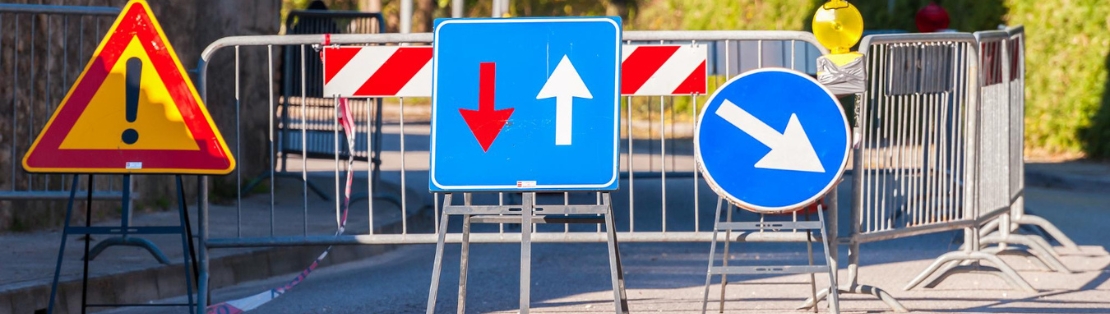
When a contraflow is in operation, traffic from both directions is funnelled onto one side of the road. The lanes are divided using physical barriers such as cones, temporary barriers, and cat's eyes so that drivers travelling in opposite directions do not collide.
Here is what typically happens:
- One carriageway is closed off (usually for roadworks or an incident)
- Both directions of traffic share the remaining carriageway
- Lanes are narrowed and clearly marked to separate opposing flows
- Reduced speed limits are introduced for safety
- Signage warns drivers well in advance that a contraflow is ahead
Because the lanes are narrower than normal and traffic is passing much closer in opposing directions, drivers are required to slow down and pay close attention to lane markings and instructions.
Contraflow System on Motorways
The most common place you will encounter a contraflow system as a driver in the UK is on a motorway. A contraflow system on a motorway is usually set up during lengthy roadworks, where one carriageway needs to be completely closed for weeks or even months at a time.
On a contraflow motorway, all traffic in both directions is directed onto one side of the motorway. The central reservation is crossed using a specially constructed gap, and temporary barriers are installed to separate the opposing lanes of traffic.
Key things to know about motorway contraflow systems:
- No hard shoulder. In a motorway contraflow, the hard shoulder is typically incorporated into the contraflow lanes to increase capacity. This means there is nowhere to pull over if you break down. If your vehicle develops a problem, you must contact the roadworks operator immediately, as they will dispatch assistance.
- Narrow lanes. The lanes within a contraflow system on a motorway are significantly narrower than standard motorway lanes. Stay well within your lane markings and avoid any sudden or wide steering movements.
- Reduced speed limits. A mandatory lower speed limit often 50mph or lower will be in force throughout the contraflow. These limits are enforced by average speed cameras in many cases, so make sure you comply for the entire duration of the contraflow, not just near the cameras.
- Stay in your lane. Once you have entered a lane in the contraflow, remain in it unless directed otherwise by signs or gantry signals. Lane changing in a contraflow is dangerous because lanes are narrower and visibility may be limited.
- Greater following distance. Because you are travelling near oncoming traffic with no central reservation between you, maintaining a larger gap to the vehicle in front gives you more time to react if something goes wrong.
A contraflow system on a motorway can be unsettling the first time you drive through one, but as long as you follow the reduced speed limit, stay in your lane, and keep your concentration, they are straightforward to navigate.
Where Are Contraflow Systems Typically Used?
Contraflow systems are used on a variety of road types across the UK. While motorways and A roads are the most common locations, you can also find contraflow arrangements in towns and cities.
- Motorways and dual carriageways are the most frequent locations for large-scale contraflow systems, typically during roadworks or following serious incidents.
- A road may have contraflow systems in place when major repairs are needed and there is no alternative route for traffic. On A roads, temporary traffic lights are often used alongside the contraflow to manage the flow of vehicles.
- Town centres and urban roads may have contraflow bus lanes or cycle lanes, which are a permanent or semi-permanent feature rather than a temporary measure. These are designed to improve public transport and cycling infrastructure rather than manage roadworks.
- B roads and country lanes can occasionally have contraflow systems in place, usually controlled by temporary traffic lights and accompanied by signs directing drivers to alternative routes.
What is a Contraflow Bus Lane?
A contraflow bus lane is a dedicated lane on a one-way street or road where buses (and sometimes other permitted vehicles) are allowed to travel in the opposite direction to the general flow of traffic.
So where would you see a contraflow bus lane? They are most found in town and city centres across the UK, on roads that have been converted to one-way systems for general traffic. Rather than forcing buses to take a lengthy detour around a one-way system, a contraflow bus lane lets them travel directly through it, saving time and making bus services more efficient.
What is a contraflow bus lane used for?
- To reduce bus journey times in urban areas
- To encourage the use of public transport
- To prevent buses from having to make long detours on one-way road systems
Who can use a contraflow bus lane? In most cases, only buses are permitted to use a contraflow bus lane. Some contraflow bus lanes may also allow taxis or motorcycles, but this will be indicated on the signs. As a car driver, you should not drive in a contraflow bus lane unless the signage explicitly permits it, doing so could result in a Penalty Charge Notice (PCN).
Contraflow bus lanes are clearly signposted, and road markings are used to show the direction of travel. Signs are typically blue and show the permitted vehicle types, the direction of travel in the contraflow lane, and the hours of operation (some contraflow bus lanes only operate during peak hours).
What is a Contraflow Cycle Lane?
A contraflow cycle lane works on the same principle as a contraflow bus lane but is reserved for cyclists. It allows cyclists to travel in the opposite direction to general traffic on a one-way road.
Contraflow cycle lanes are increasingly common in UK towns and cities as cycling infrastructure improves. They allow cyclists to take more direct routes without having to follow the one-way system imposed on motor vehicles, reducing journey times and improving safety.
Contraflow cycle lanes are usually separated from the main carriageway by a solid white line and are clearly signed. As a driver, you should be aware that cyclists may be approaching you from the opposite direction on a one-way street if a contraflow cycle lane is in operation, always check before turning or opening your door.
With-Flow Bus and Cycle Lanes
It is worth noting the difference between a contraflow bus lane and a with-flow bus lane.
A with-flow bus lane runs in the same direction as the adjacent traffic. It simply gives buses (and sometimes cyclists) their own dedicated space to avoid being held up in general traffic queues.
A contraflow bus lane, by contrast, runs against the direction of the general traffic flow.
Both types of lanes are marked with road markings and signs but understanding which direction they run in is important so you do not accidentally enter one when you should not.
Road Signs for Contraflow Bus and Cycle Lane Systems
Knowing what contraflow signs look like is important for both your theory test and for driving safely on the road.
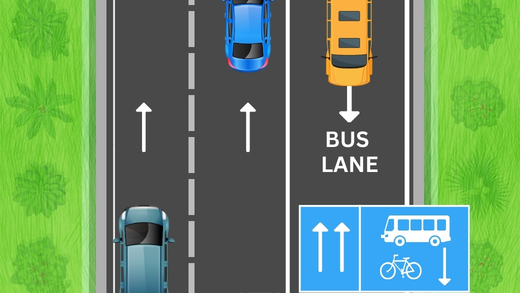
- Contraflow bus lane sign: A blue rectangular sign showing a bus (and any other permitted vehicles) travelling in one direction, with an arrow indicating the contraflow direction. This sign will also show the hours during which the lane operates.
- Contraflow cycle lane sign: Similar in appearance to the contraflow bus lane sign but showing a cyclist symbol instead of a bus. These signs are also blue and show the direction of travel.
- Motorway contraflow signs: On motorways, contraflow systems are indicated by advance warning signs before the contraflow begins. These signs have a yellow background with black arrows showing the lane arrangement, red hatched areas indicating closed lanes, and the reduced speed limit that applies in the contraflow.
You may also see:
- Temporary red and white barrier posts separating lanes
- Cones marking the lane boundaries
- Temporary cat's eyes embedded in the road surface
- Variable message signs on gantries providing real-time information
Benefits of a Contraflow System
Contraflow systems might seem inconvenient when you are stuck in a queue approaching roadworks, but they offer significant benefits:
- Keeps traffic moving. Without a contraflow system, one entire carriageway being closed for roadworks could bring traffic to a complete standstill. A contraflow allows both directions of traffic to continue moving, reducing delays significantly.
- Allows essential maintenance. Roads and motorways need regular maintenance to remain safe. Contraflow systems make it possible to carry out these works without completely shutting a major road.
- Improves public transport efficiency. Contraflow bus lanes allow buses to bypass congestion and one-way systems, making public transport a more attractive option and helping to reduce overall traffic volumes.
- Supports active travel. Contraflow cycle lanes make cycling a more viable option for short urban journeys, encouraging people to leave their cars at home.
- Maintains emergency access. By keeping traffic moving through managed contraflow systems rather than stopping it entirely, emergency vehicles can still navigate affected areas more effectively.
The Contraflow System and the DVSA Theory Test
The contraflow system is a topic that can appear in the DVSA theory test, so it is important that learner drivers understand it fully before taking their test.
Questions about contraflow systems in the theory test may cover:
- What a contraflow system is and what it means
- What you should expect when driving through a contraflow system on a motorway (for example, narrow lanes, no hard shoulder, reduced speed limits)
- What a contraflow bus lane is and who is permitted to use it
- What the road signs for contraflow systems look like
One commonly tested question is: "Where would you expect to find a contraflow bus lane?" The answer is on a one-way street, where buses are permitted to travel in the opposite direction to other traffic.
Another common topic is what happens if your vehicle breaks down in a motorway contraflow. Because there is no hard shoulder, you cannot pull over in the conventional way, you must contact the roadworks operator or follow any instructions given by signs or overhead gantries.
Make sure you are familiar with the relevant road signs and the rules that apply in contraflow situations before sitting your theory test.
Ready to Drive with Confidence?
Understanding traffic systems like contraflow systems is one of the many things that separates a nervous learner from a genuinely confident driver. The more familiar you are with how UK roads are managed, the better prepared you will be for whatever you encounter on your journeys.
From motorway contraflows and reduced speed limits to contraflow bus lanes in busy city centres, every piece of knowledge you build up makes you a safer and more capable road user. And that knowledge does not just help you pass your theory test, it stays with you for life.
Of course, being a prepared driver means thinking beyond the road itself. Warranty Direct has been helping UK drivers protect their vehicles for over 25 years, offering trusted extended car warranty with breakdown cover that means you are never left stranded when something goes wrong. Because even the most confident, knowledgeable driver cannot predict when their car will let them down.
Get a quote from Warranty Direct today and make sure you are covered for every journey ahead.
Frequently Asked Questions
1. What does contraflow mean?
Contraflow means traffic travelling in the opposite direction to the normal flow. A contraflow system is a traffic management arrangement that temporarily or permanently routes vehicles against the usual direction of travel on a road or lane.
2. What is a contraflow bus lane?
A contraflow bus lane is a lane on a one-way road or street where buses (and sometimes other permitted vehicles) are allowed to travel in the opposite direction to other traffic.
3. Where would you see a contraflow bus lane?
Contraflow bus lanes are typically found in town and city centres, on roads that operate as one-way systems for general traffic. They are common throughout the UK in urban areas.
4. What is a contraflow cycle lane?
A contraflow cycle lane is a lane that allows cyclists to travel in the opposite direction to motor vehicles on a one-way road, enabling them to take more direct routes.
5. What should I do if I break down in a motorway contraflow?
Because a motorway contraflow has no hard shoulder, you cannot pull over as normal. You should contact the roadworks operator using the emergency number displayed on signs in the contraflow, and follow any instructions shown on overhead gantries or given by traffic management personnel.
6. What speed limit applies in a contraflow system on a motorway?
Contraflow systems on motorways have a mandatory reduced speed limit, typically 50mph or lower. This limit is often enforced by average speed cameras throughout the length of the contraflow. Always follow the posted speed limit for the entire duration of the contraflow.
7. Can I change lanes in a contraflow system?
You should not change lanes in a contraflow system unless directed to do so by signs or gantry signals. Lanes in contraflow systems are narrower than normal, and lane changes can be dangerous because opposing traffic is in close proximity.
8. How long do contraflow systems last?
This varies considerably. A contraflow system on a motorway for major roadworks can be in place for several months. A contraflow set up following a road traffic incident might only last a few hours. Always follow the signs and check for updates before you travel if you know a contraflow is affecting your route.